Winning a national award for indoor air quality helps your school and community.
Applying for the indoor air quality-focused Magna Award may seem complicated, but it doesn't have to be. Jill Buck, founder and CEO of the Go Green Initiative, and team offer a step-by-step how-to guide and valuable pro tips for putting together an award-worthy application.
September 15, 2026
 ANDREY POPOV/STOCK.ADOBE.COM
The Magna Awards have been honoring school board and school district excellence and innovation for more than 30 years. Last year the awards program turned its focus to indoor air quality (IAQ) via a partnership between NSBA and the Go Green Initiative.
The 2027 class of the Magna Awards Grand Prizes will be awarded to a rural, urban, and suburban school district to recognize excellence from a wide range of educational settings. The Grand Prize winners receive $5,000, a trophy, and the opportunity to present their work at the NSBA Annual Conference in April 2027.
Multiple Silver Award winners will receive a trophy and recognition at the Annual Conference. Both the Grand Prize and Silver Award winners will be featured in the April 2027 issue of American School Board Journal, and will receive a press release to send to local media outlets.
A Magna Award helps your district
The deadline for submitting your application is Oct. 31. If you’re trying to decide if you and your district should apply, here are several reasons why winning a national award for IAQ is beneficial to your district and community.
- Labor relations and workforce retention
Teachers’ unions in many parts of the U.S. are concerned about IAQ. Not surprisingly, the pandemic led unions to partner with districts to use federal funding to improve IAQ, and the National Education Association provides its members with a five-page fact sheet “Addressing Indoor Air Quality in Schools” (NEA, 2023). Twenty-eight states and territories have OSHA-approved state plans that cover state and local government workers and include IAQ requirements (OSHA, 2026).
Creating an IAQ Plan for your district not only helps you earn points toward the Magna Award, but it also helps you demonstrate that your district is committed to providing a healthy place for people to work and learn. Your board’s commitment can be a factor in attracting and retaining the best teachers.
- Stewardship of taxpayer dollars
One of the ways to earn points for the Magna Award is to track your district’s energy consumption. Energy bills are typically the second largest line item in a district’s budget, behind payroll. It is virtually impossible to know if your district is wasting energy (and money) without tracking consumption and benchmarking your district’s energy usage against other school buildings in your area. The free online courses that are part of the Magna Award application teach you step-by-step methods to do this for free. Outside contractors are not required to gain this valuable information that can help you identify which buildings in your district may be using a disproportionate amount of energy and driving up utility costs. The Go Green Initiative can help you identify the buildings in your district that are the most energy inefficient, and develop a plan to address those issues.
If you are trying to pass a bond measure and want to show your voters that you’ve done your due diligence to assess the needs of your facilities, the documentation involved in the Magna Awards can demonstrate your analysis efforts.
- Address absenteeism
School closings due to extreme heat, wildfire smoke, and cold/flu season can be a thing of the past for your district. IAQ Management Plans address each of these increasingly frequent situations that can cause students to miss school. In addition, IAQ plans address mold, chemicals, and other irritants that can cause absenteeism for students, teachers, and staff with respiratory sensitivities.
- Comply with state law
As of press time, the following states require IAQ plans: Connecticut, Minnesota, New Jersey, New York, Oregon, Virginia, and Wisconsin.
The following states require some components of an IAQ plan for schools: Delaware, the District of Columbia, Indiana, New Hampshire, Rhode Island, Washington, and West Virginia.
The following states encourage IAQ plans for schools: Arizona, California, Colorado, Hawaii, Illinois, Kentucky, Maine, Michigan, Nevada, Tennessee, Texas, and Vermont.
Twenty-six states have legislation on IAQ in schools, and more are expected to follow. You may as well earn a Magna Award for working toward compliance.
The fastest path to 500 points
Earning points toward a Magna Award is objective and attainable for all school districts. This chart shows the breakdown of points:
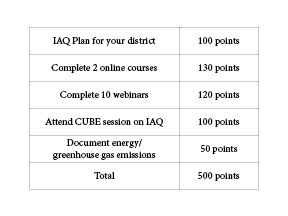
IAQ plan for your district
The Go Green Initiative has provided a template you can use to create an IAQ Plan that is aligned with both the U.S. EPA’s Tools for Schools and the Center for Green School’s toolkit for implementing Energy Efficient IAQ Management Plans. To access the template, go to https://gogreeninitiative.org/iaq-management-plans/ and click on “GGI Template IAQ Management Plan.” You also can use this QR code.

The template is designed to help you quickly customize each section for your district.
Pro Tip #1: It is possible to knock this item out in a two-hour meeting with your facilities director. Provide them with the template ahead of time and ask them to note anything that may be problematic. Consider making it a lunch meeting and provide some nice treats to make the work less onerous.
Complete two online courses
The courses for Magna Award points are found at https://gogreeninitiative.org/courses-iaq/. Take “Course 1: Creating an Energy Efficient IAQ Management Plan” and “Course 2: Documenting GHG Emissions & Using ENERGY STAR® Portfolio Manager®.”
Course 1 includes nine brief lessons, and Course 2 includes four lessons for a total of 13. Each lesson has a short quiz at the end. When you pass the quiz, you will automatically be emailed a Certificate of Completion in PDF format. Save the certificate to upload into the Magna Award application.
Pro Tip #2: You don’t have to have one person take all the lessons—divide them up and as long as someone from your district has a certificate for each lesson, your district is covered.
Complete 10 webinars
Pick 10 webinars from our YouTube playlist (https://tinyurl.com/84a2kzux) and earn a Certificate of Completion (link in each video description). Once again, you don’t have to have one person do them all. As long as the team from your district has a certificate for 10 different webinars, you will earn the certificate.
Attend CUBE session on IAQ
If you are attending the Council of Urban Boards of Education (CUBE) Conference in Chicago in October, send someone from your team to the education session presented by the Go Green Initiative on IAQ and energy efficiency. The session will feature two school districts that have excelled at IAQ management and energy efficiency. They will provide best practices learned by doing this work. At the end of the education session, scan your badge so your district gets credit (and 100 points) for attending.
Document energy/GHG emissions
This is admittedly the most difficult item on the Magna Award application if your district is unfamiliar with using the EPA’s ENERGY STAR® Portfolio Manager® tool. However, “Course 2: Documenting GHG Emissions & Using ENERGY STAR® Portfolio Manager®” mentioned above walks you through the process in a very simple, straightforward manner.
Pro Tip #3: Meet with your facilities director and the person in your district who pays your energy bills. The information you will need to complete this task will be found on your gas and electricity bills. Have the past 12 months of your bills pulled and organized to speed up the process of completing this task.
Tie-breakers: What if everyone earns 500 points?
There are three open-ended questions that can make or break your application. If you earn the same number of points as other outstanding districts, the answers to these questions will break the tie.
We’re looking for answers that will inspire other districts to follow in your footsteps. Magna Award winners are leaders whose example helps districts in similar communities and in similar circumstances envision themselves aspiring to new heights. Use these three open-ended questions to tell the unique story of why your district deserves to be held up as a role model.
This is what the judges are looking for:
Question 1: Describe your district and community, including student demographics (earn up to 5 points)
Rubric:
- 0 - Applicant left this answer blank
- 1 - Applicant did not do an adequate job of describing their community
- 2 - Applicant’s description of their community is unlikely to inspire others
- 3 - Applicant gave an adequate description of their community that may inspire others
- 4 - Applicant gave a robust description of their community that will inspire others
- 5 - Applicant’s description of their community is inspiring and worthy of recognition at the highest levels
Question 2: In what ways did your school board support the creation of the program and its continued success? (earn up to 5 points)
Rubric:
- 0 - Applicant left this answer blank
- 1 - Little or no board support
- 2 - Board’s involvement is not worthy of recognition
- 3 - Board support was adequate, but not exemplary
- 4 - Board support is what we would like to see other boards replicate
- 5 - Board support is inspiring and worthy of recognition at the highest levels
Question 3: Additional Comments (earn up to 5 points)
Rubric:
- 0 - Applicant left this answer blank
- 1 - Comments are not noteworthy
- 2 - Comments do not inspire recognition for this district
- 3 - Comments are interesting, but not inspiring for an award winner
- 4 - Comments are exciting and/or inspiring, and may inspire other districts
- 5 - Comments demonstrate excellence at the highest levels that will be inspiring to others
Reach out for help
Representatives from the Go Green Initiative will help you with your Magna Award application. They will answer any questions you may have. Email them at Magna@gogreeninitiative.org for support.