Written by education policy analyst Liz Cohen, The Future of Tutoring is based on a four-year study of the expanding K–12 tutoring movement. It emphasizes what can be accomplished when people, funding, and a passion for student learning align, while addressing the challenges and successes of a broad spectrum of tutoring initiatives, writes reviewer Karen Kopitsky.
March 23, 2026
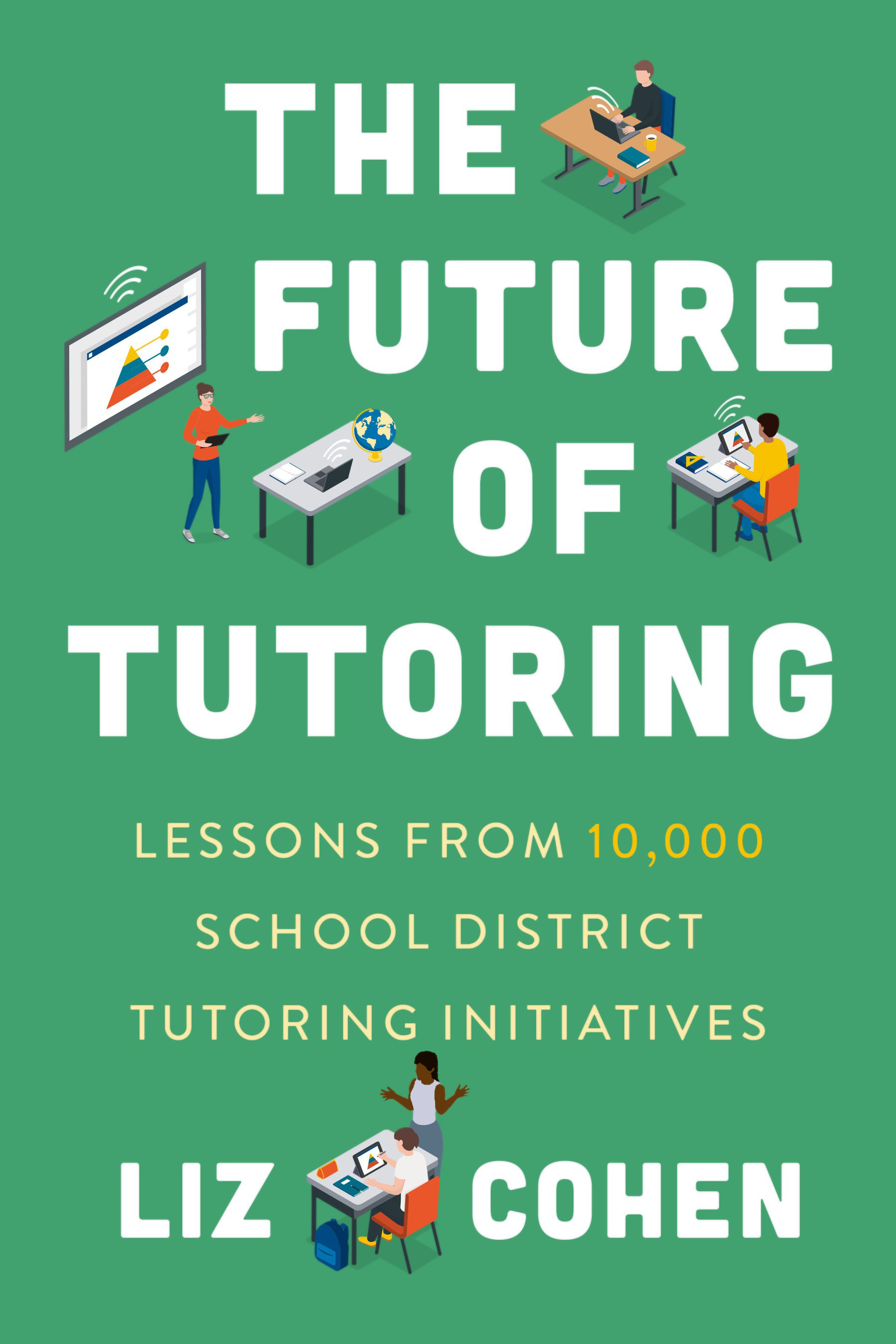 PHOTO CREDIT: HARVARD EDUCATION PRESS
In The Future of Tutoring: Lessons From 10,000 School District Tutoring Initiatives (Harvard Education Press), author Liz Cohen shares what she learned during her four-year investigation of tutoring in the United States. Cohen shows what can be accomplished when people, money, and a desire to impact and support student learning come together. The book can be read holistically or in pieces by readers who are looking for specific information, particular types of tutoring programs or tutors, or specific school contexts. Cohen describes the role the COVID-19 pandemic played in expanding tutoring, especially as it relates to the American Rescue Plan Elementary and Secondary School Emergency Relief Fund (ESSER)—funding available to assist schools in supporting students in response to the pandemic and children’s learning loss during that time. She provides a glimpse into how some schools used those funds and how they are grappling with continuing to fund their tutoring efforts going forward.
Cohen cites Stanford University’s National Student Support Accelerator when explaining the components of high-impact tutoring. To meet the definition, tutoring has to occur a minimum of three times each week for 30 minutes or more with the same tutor supporting students in groups of four or fewer. In her analysis of the programs, she points out whether each program meets this definition. She notes that even where all components of high-impact tutoring are not in place, students may still experience learning growth. At the same time, she highlights the growth potential when all components are present. At the end of several chapters, to support those interested in employing tutoring, Cohen offers what she terms “practical advice,” providing real-world guidance and/or emphasizing issues that those contemplating tutoring should consider.
The Future of Tutoring includes a who’s who of the high-impact tutoring movement in the U.S. Cohen highlights districts and states, public schools and charter schools, and other actors who have entered the tutoring space. As someone who spent time in a variety of different schools, in various tutoring programs, and with tutoring advocates, Cohen speaks with both authority and as one deeply invested in the tutoring movement. While that close proximity could lead readers to wonder whether Cohen might describe only the positives of the various tutoring initiatives, she instead discusses both the challenges and successes.
Cohen identifies the wide variety of programs, tutors, delivery methods, and curricula used in tutoring. She acknowledges the high cost of setting up, running, and scaling a tutoring program. Indeed, the expense may be very difficult for some schools to overcome. Her research offers suggestions for potential sources of tutors and notes the possible relationships that could be leveraged between universities, educator preparation programs, and school districts.
Anyone interested in incorporating high-impact tutoring into their school or district should read Cohen’s book. While she notes that much has been done in high-impact tutoring over the last four years, she emphasizes that there is still much to learn. While the question remains whether tutoring will find an enduring place within K-12 schools, Cohen advocates that it should.
Karen S. Kopitsky (kkopitsk@charlotte.edu) is a doctoral student at the University of North Carolina at Charlotte.